The Ministry of Jesus
The second theme in the Creation and the New Creation series of windows at the church of
Saints Leonard and Fergus, Dundee.
The second of the three main themes that weave their way around the windows of this church is The Ministry of Jesus. This theme starts at Window 2: The Resurrection and ends at the final window of the series, Window 24: The Light.
Dad was given free rein to choose which events to feature. Instinctively he didn’t pick any of the most well-known miracles such as the wedding at Cana, the healing of the blind or the raising of Lazarus. Rather, he focussed on stories that he felt reflected the humanity of Jesus and parables that felt particularly meaningful to him.
There are ten such events featured in the windows. The first two are Jesus’s resurrection at the end of his earthly ministry, and his baptism at the beginning (in that order). They are followed by a group of four stories from Jesus’s life as an itinerant preacher, travelling and teaching in Galilee and surrounding areas. Dad regarded the windows containing these stories as the ‘preparation windows’ because they depict activities of Jesus that challenged the religious authorities at the time, preparing Jesus, ultimately, for his death on a cross. If we stand in the church, facing the altar, they are all on the left side of the church.
Before moving on to the last four events in the ministry of Jesus detailed here, which are all on the right side of the church as we stand facing the altar, there is an ‘interlude’. This interlude offers something of a pause, where the importance of the altar as the focal point of both Jesus’s ministry and the sacrament of the Eucharist is highlighted.
Following this interlude we return to the events in Jesus’s ministry. The final four events are found in what Dad regarded as the ‘teaching windows’ in that they are four teaching stories, or parables, told by Jesus to his followers.
Unfortunately, it hasn’t been possible to include all the images mentioned on this page, so if you want to see the missing ones and read more details about the design, symbolism and overlapping themes and ideas in each window, click on the links to the relevant windows. All biblical quotations are from the New Revised Standard Version (NRSV) unless otherwise indicated.
Jesus’s Resurrection
First, the scene is set with Jesus’s resurrection in Window 2: The Resurrection. The event was not described by the gospel writers, rather they recorded the empty tomb and appearances of the risen Jesus after his crucifixion (see Matthew 28, Mark 16, Luke 24 and John 20-21).

The abstracted Pascal candle, symbolising Jesus's resurrection (Window 2: The Resurrection).
.jpg)
Jesus's resurrection in the transom, based on a medieval illumination found in the thirteenth century manuscript, the York Psalter (Window 2: The Resurrection).
While it might initially seem odd to position what happened after Jesus’ death before the events in his earthly life, Fr McInally who was the parish priest of the church at the time Dad made these windows, wanted Jesus’s resurrection to be placed at the beginning rather than at the end of the windows. This is because his resurrection and ascension into heaven marked a new beginning: the beginning of his heavenly life as the risen Christ and the dawn of the New Creation. Jesus’s resurrection also provides the context in which the other stories are understood; they would not mean much if there had been no resurrection, he would have simply been another itinerant teacher who died like everyone else. In addition, while it might not make sense on a linear timeline, it makes sense in terms of the liturgical calendar which cycles in perpetuity with no beginning and no end.
Jesus’s resurrection and the creation of light on the first day of creation (see The Days of Creation theme) are both represented by an abstracted Pascal candle in the main window, with a candle flame and the five grains of incense embedded in the candle representing the five wounds of Jesus. Liturgically, a new Paschal candle is lit and blessed every year at Easter. It represents the light of the risen
Christ, and life coming into the world to dispel darkness and death. In this overlap, Creation and New Creation come together.
The Resurrection is also represented pictorially in the transom of the window, based on an illumination from the thirteenth century manuscript, the York Psalter, folio 59v.
Jesus’s Baptism
Jesus’s ministry began when he was about thirty years old following his baptism by John the Baptist in the river Jordan (Matthew 3.13-17, Mark 1.9-11, Luke 3.21-22).
Jesus’s baptism merges with the Christian sacrament of Baptism in Window 5: Baptism, so this window features in the current theme, The Ministry of Jesus and in the theme of The Seven Sacraments (forthcoming). They are symbolically depicted in the main window by the Holy Spirit as a dove hovering over the waters. The Holy Spirit is traditionally associated with a dove, based on the four gospel accounts of Jesus’s baptism, ‘And when Jesus had been baptised, just as he came up from the water, suddenly the heavens were opened to him and he saw the Spirit of God descending like a dove and alighting on him’ (Matthew 3.16).
The Temptation of Jesus
Immediately after his baptism, Jesus was led by the Spirit into the wilderness to be tempted by the devil. This event is the first of four in the ‘preparation windows' belonging to The Ministry of Jesus theme circling the windows in the church. It is the focus of Window 6: The Temptation.

The Spirit of God, descending like a dove at Jesus's Baptism (Window 5: Baptism).

The Temptation of Jesus, showing Dundee landmarks, (Window 6: The Temptation).
In the biblical story, after fasting for forty days, the devil approached Jesus and challenged him, ‘If you are the Son of God, command these stones to become loaves of bread’. After Jesus rebuked him, the devil tried to tempt him a second time by taking him to the pinnacle of the temple, saying, ‘If you are the Son of God, throw yourself down; for it is written, “He will command his angels concerning you”’. The devil tried one more time. He ‘took him to a very high mountain and showed him all the kingdoms of the world’ and said to him, ‘All these I will give you, if you will fall down and worship me.’ Jesus told him, ‘Away with you, Satan! For it is written, “Worship the Lord your God, and serve only him”’ (Matthew 4.1-11, see also Mark 1.12-13 and Luke 4.1-13).
Instead of locating Jesus’s temptation in the Judean desert, Dad located it in Dundee, using notable Dundee landmarks. (The development of this idea, including the change from the Judean desert to a Scottish location and the way the design changed from three separate roundels to the detailed picture we have here is written about more fully in Window 6: The Temptation.)
The Sidlaw Hills represent the wilderness into which the Spirit led Jesus. The tower of Steeple Church stands for the pinnacle of the temple from which the devil asks Jesus to throw himself. The ‘very high mountain’ from where Jesus could see ‘all the kingdoms of the world and their splendour’ is represented by Law Hill (formally known as Dundee Law).
In the biblical story, the devil did not succeed in tempting Jesus. To illustrate this, Dad painted a little medieval style devil that has been sent spinning out of the temptation scene. It can be seen in one of the diamonds near the top of the main window.
In the transom is a humorous reference to temptation. A fisherman, fishing in the silvery River Tay, is trying (and succeeding) to tempt a salmon out of the water (not shown on the current page).
The Woman at the Well
The next featured event in Jesus’s ministry is in Window 8: The Woman at the Well. In this story, told in John 4.1-42, Jesus had been travelling with his disciples through Samaria on their way to Galilee. When they reached the city of Sychar, Jesus sat down by Jacob’s Well. He was hot and weary and in need of a rest. A Samaritan woman
approached the well to draw water and Jesus asked her for a drink. She responded suspiciously, ‘How is it that you, a Jew, ask a drink of me, a woman of Samaria?’ (John 4.9). The conversation continued and culminated in not only her, but many more from the town, believing that Jesus was the Saviour.
In Dad’s realistic portrayal of this scene, he was most interested in capturing a very human and vulnerable moment between two strangers who unexpectedly crossed paths: the weariness of Jesus the man, worn out from his travels, and the surprise and suspicion of the woman he asked for a drink. Giving a stranger a drink is a traditional act of hospitality that all communities are familiar with, even today. In his snapshot of this tale, Dad portrays a moment of recognition of our common humanity: there is no outsider or enemy, we are all fellow human beings.
The Woman Washing Jesus’s Feet
The story of the woman washing Jesus’s feet can be found in Luke 7.36-50 and is illustrated in Window 12: Reconciliation.
In the biblical story, Jesus was invited for a meal at a Pharisee’s house and while they were eating at the table, a woman ‘who was a sinner’ heard that

Jesus meeting the woman at Jacob's Well in Sychar (Window 8: The Woman at the Well).

The woman who was a sinner, washing and anointing Jesus's feet (Window 12: Reconciliation).
Jesus was in town, bought an alabaster jar of ointment and took it to the Pharisee’s house. There, she wept and bathed Jesus’s feet with her tears and dried them with her hair. She continued to kiss his feet and anointed them with the fragrant and costly ointment she’d bought. The Pharisee who had invited Jesus into his home was not impressed and complained that if Jesus truly was a prophet, he would know this woman was a sinner.
Jesus explained that the woman, by lavishing on him precious ointment and by washing his feet with her tears, was showing more love than the Pharisee had – the Pharisee hadn’t even given Jesus any water to wash his feet. Jesus explained to the Pharisee, by way of a parable, that because she had sinned greatly and had been forgiven, she was able to love greatly. By contrast, someone who has only sinned a little and has been forgiven, does not love as much. Jesus concluded, ‘Therefore, I tell you, her sins, which were many, have been forgiven; hence she has shown great love. But the one to whom little is forgiven, loves little.’ He ended by saying to her, ‘Your faith has saved you; go in peace.’
Dad, using his own design, portrayed a moment in this scene where the woman, bowed in humility, is drying Jesus’s feet with her flowing hair, a jug of water and alabaster jar beside her. The Pharisee is looking on with annoyance at her audacity – look at the expression on his face and the way his hand is gripping the edge of the table! Jesus’s left hand is outstretched as if to say to the Pharisee, ‘Hang on a minute, let me explain …’
This story is a story of forgiveness – Jesus forgave the woman for her sins – which
is why it is located in Window 12: Reconciliation where it overlaps with the sacrament of Reconciliation, also known as Confession or Penance. As such the window also features in the third main theme weaving its way around these windows, The Seven Sacraments.
The Calling of Peter and Andrew
The Calling of the Apostles was a key event in Jesus’s ministry. Twelve apostles were called, or commissioned, by Jesus from among his followers to be the primary teachers of his gospel message. This event is commonly called the Commissioning of the Twelve Apostles or the Great Commission (Matthew 10.1-4, Mark 3.13-19, Luke 6.12-16).
To illustrate this, Dad chose to focus on the calling of the first apostles, Peter and Andrew, in Window 13: Saints Peter & Andrew. Variations of the biblical story are found in all four gospels (see Matthew 4.18-19, Mark 1.16-18, Luke 5.2-9, John 1.40-42). The Matthean account reads, ‘Now as Jesus was walking by the Sea of Galilee, he saw two brothers, Simon, who was called Peter, and his brother Andrew, casting a net into the sea; for they were fishermen. And he said to them, “Follow me, and I will make you fishers of people.” Immediately they left their nets and followed him’ (Matthew 4.18-20 NASB).
In Dad’s portrayal of this scene, he depicts two ordinary men, going about their daily business of fishing, looking startled at being commissioned by Jesus. They look over their left shoulders in the direction of the voice calling them from the bank of the lake. From our perspective they are looking directly towards the

The fishermen, Peter & Andrew, being commissioned by Jesus (Window 13: Saints Peter & Andrew).
altar, where Jesus Christ is present in the sacrament of the Eucharist. Notice the boat's mast forming a white cross behind them, foreshadowing Jesus's crucifixion which is to come.

Window 14: The Eucharistic Bread.
Interlude: The Altar
Before moving on to the final four events in the ministry of Jesus detailed here, we pause for a moment to imagine ourselves standing in the church itself in order to understand why certain key events in Jesus's ministry have not been included in these windows.
In the story just discussed, Peter and Andrew are depicted looking directly at the altar where Jesus Christ is present in the Eucharist. Standing in the church, facing the altar, we see these apostles are to the left of the altar in the penultimate window of the Winter and Spring windows, window 13. Following their gaze, we too, look at the altar which is flanked by the two eucharistic windows, Window 14: The Eucharistic Bread to the left and Window 15: The Eucharistic Wine to the right.
The altar is the central, most important feature of the Church and of the entire Catholic faith. Upon it, the sacrament of the Eucharist (discussed more fully in The Seven Sacraments, forthcoming) is celebrated in remembrance of the pivotal events in Jesus’s life: the Last Supper, his death and resurrection. The Eucharist is ‘the source and summit’ of Christian life, underlining the central role of the altar.
The Last Supper and Jesus’s death on a cross are not included as events in the ministry of Jesus in these windows, although the Last Supper is implied in the eucharistic windows either side of the altar, and there is a stylised image of a Crucified Christ in Window 22: Holy Orders. If they were to have been included, in chronological terms they would have to have been positioned towards the end of the windows, coming, as they do, at the end of Jesus’s earthly life, rather than here, midway through the series of windows.
However, Dad did not want an artistic representation of these events to detract from the gravitas of the altar itself, which is why he did not include them in his Ministry of Jesus theme circling the windows. Artistic representations of these pivotal events could only ever be pale shadows of the real, lived celebration of the Eucharist on the altar. All the windows, on both the left and the right of the church, ultimately lead to the altar and should never detract from it.

Window 15: The Eucharistic Wine.
The Parable of the Sower
We now turn our attention back to stories from Jesus’s ministry that Dad did include in the windows. The final four are contemporary expression of some of the parables, or teaching stories, that Jesus told his followers. They are found in the ‘teaching windows’. These teaching windows are either side of Window 22: Holy Orders in the Autumn series, to the right of the altar. Dad gave Fr McInally, the parish priest at the time, a list of the parables he planned to include in the windows. As he did with many of the other images in the windows, he asked the priest for some ideas of how they could be reimagined with a Scottish flavour.
The first is the Parable of the Sower, depicted in Window 20: The Sower. This parable is found in Matthew 13.1-23, Mark 4.1-20 and Luke 8.4-15. With a large crowd around him, Jesus tells the story of a sower who went out to sow seeds – some fell on the path where birds came and ate them, some fell on rocky ground but had no soil to sustain them so they withered, some fell among thorns that choked them. Finally, some fell on good soil and produced grain. The seed represents the Word of God, the sower is whoever proclaims it and the various soils represent people’s responses to it.

The archetypal sower of seed, a mother holding her baby (Window 20: The Sower).

The two primary schools of the parish representing the seed that fell on good soil (Window 20: The Sower).
This window contains many details, all of which relate to this parable in one way or another. The focus of the main window is the children of the parish as the seeds of our future. We start at the bottom with a little illustration of the archetypal sower of seed, a mother holding her child. Above and to the left is the child, who has grown into the ultimate cheeky schoolboy, Dennis the Menace, the well-known character from the Dundee based Beano magazine for children (not shown here).
The main image in this window, split into an upper and a lower part, is of the two primary schools attached to the parish at the time the windows were made, representing the good soil in the Parable of the Sower. The top one is of the entrance of St Fergus primary school, which is still there. The bottom one is of St Margaret's primary school which closed in 2008. Here is ordinary Dundee life, the schools playing their role in the nurturing of the citizens of the future.
Above the schools are representations of music and sport (not shown here): a character playing a violin, another playing a wind instrument and another playing golf. Together they emphasise the importance of the arts and sport in the development of children as they grow into being fully rounded adults. Two honeybees play football, each wearing their teams’ colours. The blue and white bee in goal is a supporter of Dundee F.C. and the orange and black bee supports Dundee United F.C (not shown here).
Finally, in the transom, is Galileo, the American robotic space probe that was sent by NASA to study Jupiter and its moons. The Galileo space probe here represents space exploration, the sowing of the seeds of the future scientific understanding of our universe (not shown here).
The Parable of the Good Samaritan
The next parable belonging to The Ministry of Jesus theme can be found in Window 21: The Good Samaritan.
In this second moral tale, a lawyer asked Jesus what he should do to inherit eternal life. After Jesus told him that he should love God and love his neighbour as himself, the lawyer asked, ‘and who is my neighbour?’ By way of an answer, Jesus told the following story: a traveller got attacked by robbers and was left, half dead, on the roadside. A priest walking by, noticed the man’s plight, and crossed the road to avoid him. A Levite did likewise. Then a Samaritan came to where the poor fellow was lying and took pity on him, bandaged his wounds and took him to an inn where he could be

Picasso-esque man in a wheelchair (Window 21: The Good Samaritan).
cared for properly. Jesus asked the lawyer, ‘which of these three, do you think, was a neighbour to the man who fell into the hands of robbers?’ The lawyer answered, ‘The one who showed him mercy’ and Jesus told him to ‘Go and do likewise’ (Luke 10.25-37).
In this window, Ninewells Hospital in Dundee takes pride of place, an emblem of the compassion and never-ending work of those with a vocation to the caring professions. Such people do not choose who they care for, they minister to whoever needs their attention. Featuring an ambulance, a sign to the maternity wing and a mobile blood transfusion unit, Dad gave this image a simple 1960s feel to reflect the fact that construction of the building project began in 1964.
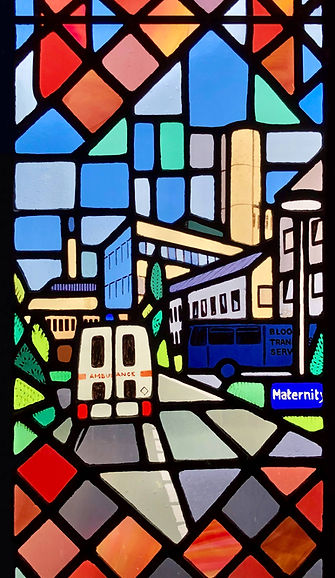
Ninewells Hospital, Dundee, an emblem of compassion and care (Window 21: The Good Samaritan).

The River Tay bridges as symbols of the prodigal son's leaving and returning (Window 23: The Prodigal Son).
Below the main image is a sensitively portrayed painting of a man in a wheelchair. This is Dad’s own design, but with a Picasso influence.
At the bottom of the window are three honeybees in a little vignette of the Good Samaritan parable (not shown here). One bee is coming to the aid of an injured bee, while another is seen flying away from the scene, pretending not to have noticed.
The Parable of the Prodigal Son
The third parable is found in Window 23: The Prodigal Son. The story appears in Luke 15.11-32 where Jesus tells a story of the younger of two sons who demanded his inheritance but squandered it all on ‘dissolute living’. A famine took place throughout the country and to try and earn some money, the young son went to work for a pig farmer and was sent into the fields to feed the pigs. There, at his lowest point, he decided to return home and seek his father’s forgiveness. While he was still a distance from home, his father spotted him and, filled with compassion, ran to him, put his arms around him and kissed him. He ordered a celebration for the return of his son, saying ‘this son of mine
was dead and is alive again; he was lost and is found!’ The older son resented this forgiveness because he had always worked loyally for his father and never disobeyed him.
The story illustrates God’s unconditional love for all people. No matter how far someone strays from God, that person is welcomed back if they choose to return. The older son’s reaction further reminds us that God’s love is for all, not just the seemingly faithful.
The main image in this window is a stylised Dundee, as it was at the time of the creation of these windows. The view is from Law Hill, looking out across the River Tay, with Dundee in the foreground. It shows several Dundee landmarks but the focus, however, is on the two Tay bridges, one road and one rail. They are symbolic of leaving home and returning, like the prodigal son in the parable. They look like two welcoming arms, representative of the father’s embrace.
At the bottom of the window are three pigs, indicative of the time the younger son spent feeding the pigs after he had squandered his inheritance. A little above is one of the many honeybees in the windows. She is carrying suitcases; like the prodigal son, she too is leaving home.

The joyous feast celebrating the prodigal's return, given a Scottish flavour (Window 23: The Prodigal Son).

The prodigal son spent time feeding the pigs after he had squandered his inheritance (Window 23: The Prodigal Son).

Above the scene looking across the River Tay is an image of the joyous feast celebrating the prodigal son’s return, given a Scottish flavour with the inclusion of Fr McInally at the head of the table, Scottish venison in place of the fatted calf and, taking pride of place on the table, a Dundee cake.
In the transom is the third space reference in the windows: Halley’s Comet and Giotto, the European robotic spacecraft that succeeded in approaching Halley’s nucleus on the 13th March 1986 (not shown here). In orbiting the sun every 75-76 years, the comet gives the impression of going and coming back, so is symbolic of the prodigal son’s departure and return.
The Parable of the Light (or Lamp)
Finally, the last parable belonging to The Ministry of Jesus theme is portrayed in the final window of the series, Window 24: The Light.
This parable is found in Matthew 5.14-16, Mark 4.21-23 and Luke 8.16-18. It teaches that followers should not hide their faith, but should let it shine for others to see, just as a lamp is placed on a lampstand to illuminate a room rather than being hidden ‘under the bushel basket, or under the bed’. This is where the familiar idiom, ‘don’t hide your light under a bushel’ comes from. Matthew precedes his telling of the parable with, ‘You are the light of the world’ (Matthew 5.14).
The earthly colours of the four seasons that have gradually transitioned from the cool greys and blues of Winter, through the bright, fresh greens of Spring, the warm golden yellows of Summer and the rich reds and ochres of Autumn have given way in this window to an explosion of light. The light is portrayed throughout the whole main window by yellow candle flames of light set in a background of sparkling seedy white glass. Each candle flame represents a prayerful offering of a person shining their light in their community and beyond.
As well as representing Jesus’s Parable of the Light, the window also represents the hopeful joy for the culmination of the New Creation in which all people will be caught up in eternal life in a new heaven and a new earth. It reflects some words that come almost at the end of the last book of the New Testament that speak about this New Creation, ‘the city has no need of sun or moon to shine on it, for the glory of God is its light’ (Revelation 21.23). In this regard, the candle flames in this window connect to the golden candle flame of the Paschal candle and Jesus’s own resurrection in Window 2: The Resurrection, across the doorway. And so, we return to the beginning of The Ministry of Jesus and the cycle continues.

An explosion of light with yellow candle flames representing the prayerful offerings of parishioners and the Parable of the Light (Window 24: The Light).